In March 1826, after nearly a year of tight siege and continuous defense, Missolonghi was completely cut off by the Turkish-Egyptian forces. No longer able to resupply and facing the risk of succumbing to starvation, its defenders decided to attempt an exodus from the city on the night of April 10–11, between Lazarus Saturday and Palm Sunday.
This year, we commemorate the 200th anniversary of this heroic historical moment. The Historical Library preserves important publications containing historical information, testimonies from the protagonists, and literary works inspired by the events.
From the start of the Revolution, Missolonghi was an important political and military centre. It was soon designated the seat of the Administration of Western Greece. As early as 1823, a printing house had begun operating, mainly to meet the needs of the Administration. From 1824 to 1826, the political-military newspaper “Hellenic Chronicles” was also published there. Its masthead bore Benjamin Franklin’s motto “The greatest good for the greatest number,” and its editor was the philhellene Swiss physician, Johann Jacob Meyer.
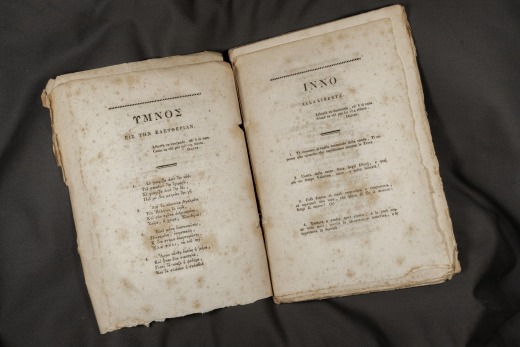
In 1825, Dionysios Solomos’s “Hymn to Liberty” was printed for the first time on Greek soil at the Missolonghi printing press, in both Greek and Italian.
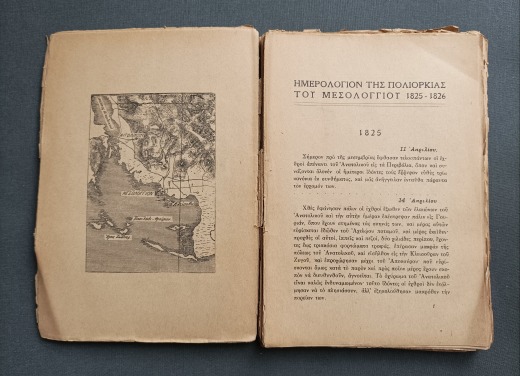
Mayer also left us the Diary of the Siege of Messolonghi, 1825-1826, which was published on the 100th anniversary of the Exodus, edited by Georgios Drosinis. It describes the events of the siege and the feelings of the city’s defenders, stopping about forty days before the Exodus. In those days, the printing house was destroyed by bombing. Both of its printers, Mayer and Dimitrios Mestheneus, were killed during the Exodus.
One of the most important and comprehensive historical sources we have on the siege and the Exodus of Missolonghi is the Military Memoirs of the Greek Revolution, 1821-1833 by Nikolaos K. Kasomoulis, edited by Giannis Vlachogiannis and published as recently as 1939–41. It presents in vivid detail not only the military and political events, but also personal accounts and anecdotes.
Kasomoulis, a fighter from Western Macedonia, fled to southern Greece after the failure of the Olympus Revolution, along with Captain Stornaris, for whom he served as secretary. He fought during the siege of Messolonghi and during the Exodus.
He himself recorded, at the dictation of the president of the council, Bishop Joseph of Rogoi, the decision/declaration of the Exodus and he also preserves from memory its entire text, which begins:
“In the name of the Holy Trinity,
Seeing ourselves, the army, and the citizens in general, young and old alike, deprived of all the urgent necessities of life for 40 days, and that we have fulfilled our duties as faithful soldiers of the homeland in this tight siege, and that, if we endure one more day, we would all die standing in the streets. Considering, on the other hand, that we have lost all hope of receiving aid and supplies, either by sea or by land, that would allow us to hold out while we are victorious over the enemy, we unanimously decided: our Exodus will take place two hours into the night of April 10, Saturday, as Palm Sunday was breaks, according to the following plan, whether help arrives or not …”
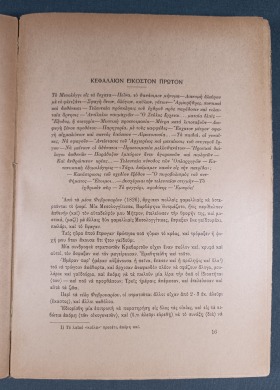
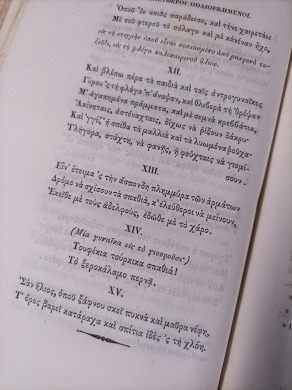
Deeply moved by these events—and drawing on his own personal experience, as from his home on the island of Zakynthos he could hear the echo of the cannon fire—Dionysios Solomos immortalized the sacrifice of the fighters in his highly influential work “The Free Besieged”. The work, which the poet wrote and rewrote for most of his life, remained unfinished and was handed down in the form of three drafts. However, with the unparalleled lyricism and dramatic intensity of its verses, it is one of the most important and best-known works of modern Greek poetry.